Nepal,  Tilicho Trek,  Trekking

Thanchowk – Tilicho Base Camp
Thanchowk – Pisang
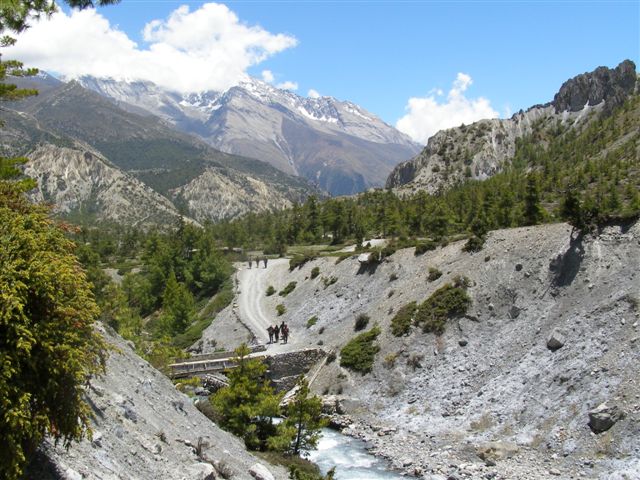
From Thanchowk we walk through a deep valley to Pisang (3200 meters) where the area becomes drier and barren. We have now walked a bit through the Himalayas and the monsoon should have less influence here and indeed from this day we have less / hardly any problems with the rain. Along the way we meet many road workers who do dangerous and unhealthy work in dangerous places, for a meager wage of rs 120 a day. In some of these places the trekking trails are narrow and steep and one of our porters finds it a bit scary. This porter turned out not to be a “real” porter but was one of the few who was willing to “take the job” in Besi Sahar. But he likes it a lot and goes to places he has never been himself. That evening in Pisang we discuss the progress and the trekking plan with guide and porters. Actually, the intention is to replace this porter, Raj Kumar (which means something like prince, in Manang for a porter who is used to walking / working at great heights. Raj Kumar, however, likes his working holiday way too much and is angry. If he has to stop in Manang, he prefers to go back immediately, after which he gets a big scolding from Sangeeta, but the discussion remains without outcome.

PisangManang 
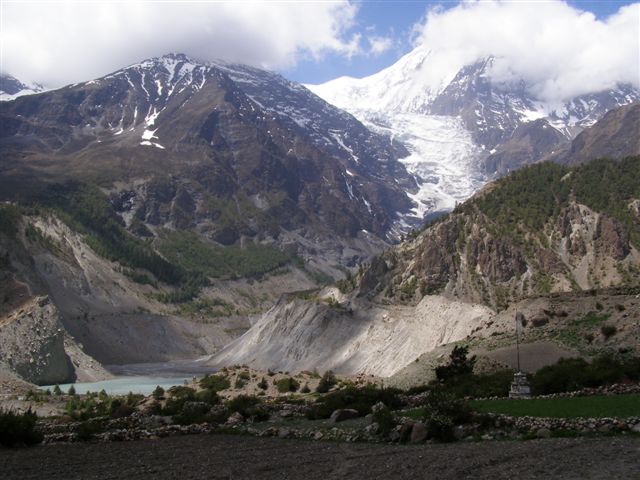
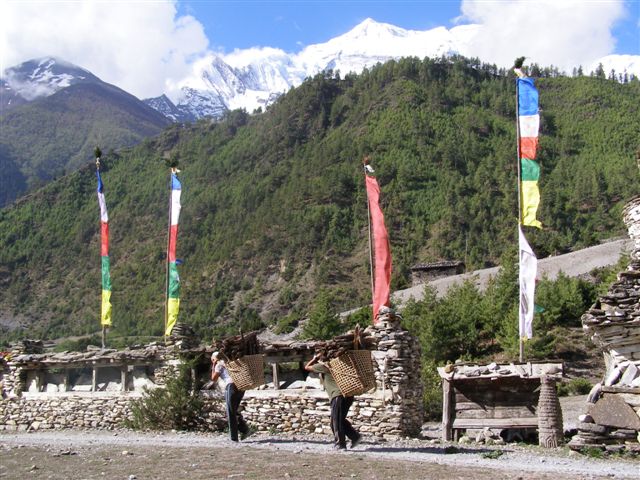
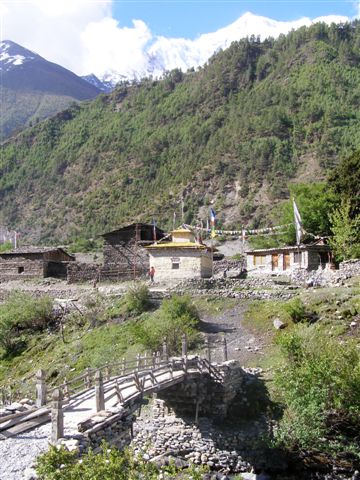
The hike from Pisang to Manang is the most beautiful day of the entire trek and one of the better hikes in all of the Himalayas. At least as far as we three have seen, together good for about 15 to 20 trekking adventures. The walk goes along the foot of the Annapurna massif and the Gangapurna peak, through cozy villages, babbling mountain streams, wilder rivers, deep valleys, beautiful rocks, open valleys. This walk takes about 4 hours, but due to the many breaks to take pictures or just stare at the surroundings for a while, it takes more than twice as long. Because we go so slowly we arrive around 4:00 pm not at all tired, but fully satisfied in Manang, a relatively prosperous mountain village, which despite the tourism (here relatively many, because more people spend the night here due to acclimatization or flying in via the nearby Hungde) still has a fairly authentic character. All three of us are very enthusiastic about the beautiful day / surroundings and we enjoy the meal for a while.

In and around Manang
Many day trips can be made from Manang, including to Braga Monastery and various other remote monasteries, Ice Lake, Gangapurna Lake, a Milarepa cave, etc. We limit ourselves to Gangapurna Lake and Braga Monastery, because the next day we will be somewhere between Khangsar and Tilicho Base Camp want to acclimatize.
In Manang, measures must be taken for camping trekking. From here we will have to sleep in tents for 3 or 4 nights and bring our own food and fuel. Buying food and fuel is not such a problem. Arranging an extra porter is. With a lot of effort we finally manage to arrange an extra porter for rs4000 for 3 days, where a normal price should be rs1500. It would have been cheaper if we had brought an extra porter all the way from Besi Sahar. We are glad that we had not arranged the entire camping trek from Manang, which we had also considered. The porter Raj Kumar is happy that he is “allowed” to go to Jomsom because of these circumstances.
For the next day, the short walk from Manang to Tilicho Peak hotel, in a lonely spot between Khangsar and Tilicho Base Camp, is on the program. So we can take it easy: sleep in, take a good shower and take a walk to Gangapurna Lake before we set off.

Manang – Tilicho Peak hotel
Soon we reach Khangsar, a Tibetan-looking town, where the wind is very strong.

After a long break in Khangsar (sort of mini acclimatization) we walk to Tare Gompa an ancient mini monastery that is still in active use and of great importance to the local population. Here we take a break, sacrifice butter lamps and sit for a while listening to the prayers mumbling monks, drinking some yak-butter tea (nice fat and a lot of calories, we can use that here). Then we walk to Tilicho Peak Hotel, a beautiful (for trekking standards) new hotel in the middle of nowhere.
The guide is in our favor, we are allowed to sleep in the hotel and do not have to enter the tents yet. The staff themselves sleep outside in tents and also prepare the food outside. The least experienced porter has demolished the stove in no time, which causes us a big problem. It is beyond repair. It is late in the afternoon and there are only two options: either no stove, or someone has to go back to Khangsar / Manang to arrange someone else or have him repaired. Actually, only the latter is an option, but an annoying one for them. We agree that they do not necessarily have to come back in the evening, but that they can also come the next morning. We’ll wait, the walk to Tilicho Base Camp isn’t that long after all. Fortunately the guide and porter already know how to arrange something in Khangsar and about 3 hours later, just before dark, they are already back.

Tilicho peak hotel – Tilicho Base Camp
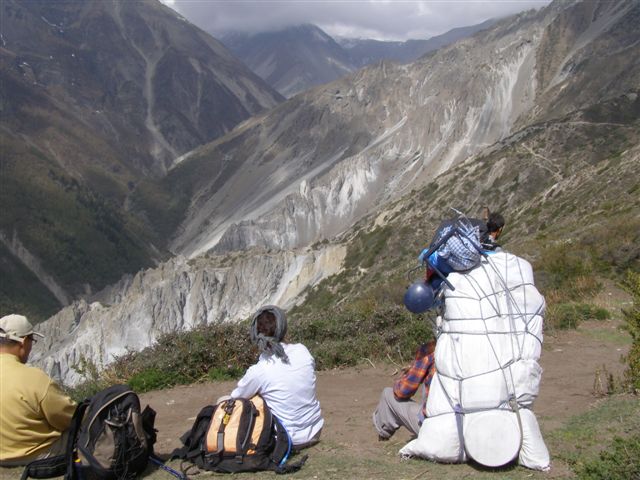
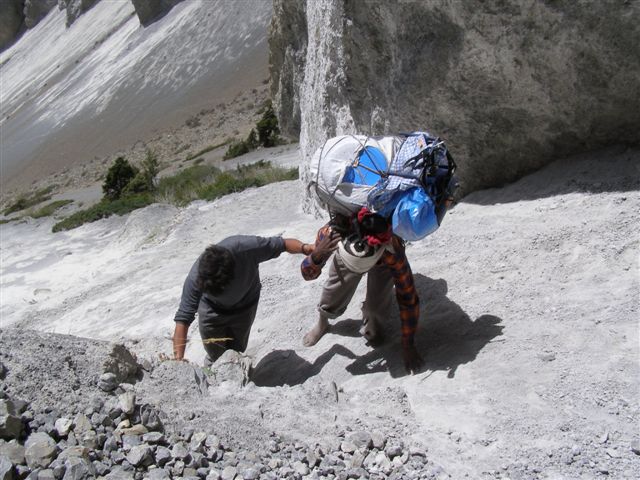
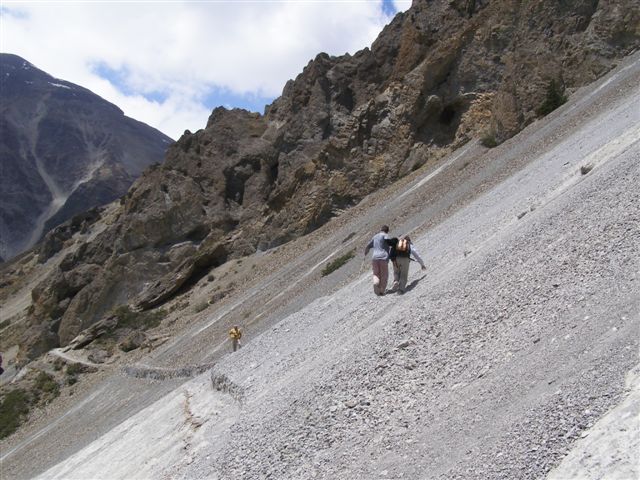
There are two routes from Tilicho peak hotel to Tilicho base camp. A dangerous, short, low route and a slightly less dangerous, high, difficult and long route. The danger of the low route appears to be in the landslide areas where, especially later in the afternoon when the wind picks up, stones can roll down. So we have to leave early to be in Tilicho base camp before then. We are used to getting up early, so that is not the problem. After a short beautiful walk through green landscape, the dry, steep landscape where (small) landslides and stone fall regularly take place after heavy rainfall. It looks impressive from a distance. What impresses Sangeeta, however, is that on one of the first parts our porter Raj Kumar does not dare to descend. If a porter does not dare …………. He is helped by one of the other porters. To nuance, such a steep descent with more than 30 kilos (possibly even more than 40) on your back is of course a lot more difficult than with a day backpack of 2 or 3 kilos.

View on "landslide-area"
Porter getting help descending
Dangerous route

Slowing moving forward
These facts don’t help Sangeeta much and for the rest of the walk to Tilicho base camp, she constantly needs the help of one or two others to help her move forward. This takes us at least twice as long on the route and slowly the wind rises and here and there small stones start to roll down. Sangeeta is really terrified, sighs, groans and groans and squeezes the hands of the helpers.
After “crawling forward” together with Sangeeta and guide for a while, we reach Santosh, who has been halfway through such a landslide area for some time now. It turns out that the stretch in front of him, which is just a few meters long, looks extremely difficult and he doesn’t know how to cross it. The guide must therefore give a demonstration. It is a stretch where the ground sinks beneath your feet, but as long as you walk fast enough, this will happen behind you and you will not fall. We have to tell Sangeeta that she has to run really fast this time and not as slow as before. I literally have to pull her over the section of path to make sure she moves forward fast enough. Not much later we reach the sign “thanks” with the announcement “landslide area” on the backside for people coming from the other side. It looks like the worst is over. Sangeeta falls down to recover from this very intense experience.
When we continue the road 10 minutes later and go twice around a “corner” of a mountain, it appears that we still have large parts of the same kind to go. Such a misleading sign leads nearly to a mental breakdown.
We wonder if the high route would not have been smarter. Once we are in Tilicho base camp and look up at the steep mountainside along which the high route should descend, but there is nowhere to be seen a trail, we know better. That had been nothing at all for Sangeeta in particular. When we see a handmade poster on the door of Tilicho Base Camp Hotel, we can’t stop laughing. Here the scree slopes that Sangeeta found so scary are advertised as a tourist attraction “Monkey-donkey-experience”. On the back of a horse up and then run down: “Scree slope down hill running”. Note: the guesthouse cannot be held liable for possible (health) damage during such an adventure.

Read more: Part 3 – Tilicho Base Camp to Tilicho

Leave a Reply